Brand Strategy: How to Define Your Position and Put It to Work
By 2 Fellas Media Team · November 17, 2026 · 10 min read
Brand strategy is the set of choices that defines who your organisation serves, what distinct value it promises, and how it will prove that promise across communications and customer experiences. For a South African business, NGO or marketing team, a useful strategy turns those choices into practical guidance for positioning, messaging, design and campaigns—not just a logo or a tagline.
Table of Contents
- What Brand Strategy decides
- Why it matters for organisations with limited resources
- How to build a usable Brand Strategy
- Turn the strategy into messages and experiences
- Measure whether the strategy is doing its job
- Recognise when the strategy needs revision
What Brand Strategy decides
A brand strategy gives your organisation a reasoned answer to three connected questions: who matters most, why they should choose or support you, and what evidence makes that promise credible. The answers should help people make decisions: what to say in a campaign, which audience to prioritise, what to emphasise on a website and which opportunities are a poor fit.
It is not the same as brand identity. Identity is how a brand is expressed visually and verbally; strategy informs the choices that expression should communicate. Nor is it a marketing calendar. A calendar schedules activity, while strategy helps determine whether the activity is aimed at the right people with a coherent proposition.
For example, an illustrative local food business might choose to serve time-poor households looking for convenient weekday meals. That choice could shape its offer, its product descriptions, the proof it provides about ingredients and preparation, and the way it presents ordering information. A broad claim such as “quality food for everyone” would give the team much less direction.
A working strategy should be clear enough to guide creative decisions and flexible enough to apply across formats. It does not require every channel to use identical wording or visuals. It does require each execution to support the same underlying promise rather than introducing a different reason to care.
Why it matters for organisations with limited resources
When a small business has limited time or budget, unclear positioning can spread effort across too many audiences, messages and channels. For an NGO, it can leave a campaign with a strong cause but no clear audience action. For a marketing team, it can mean that a polished video, website and paid campaign each tell a slightly different story. Strategic focus helps teams make trade-offs before production and media decisions become expensive to change.
A useful starting point is to describe the choice the organisation is making, not simply the activity it wants to do. “We need more social content” is a request for a format. “We need to help first-time donors understand what their contribution supports” names an audience and a communication problem. That second statement gives a creative team something concrete to solve.
- For a growing business: identify which customer group the next campaign is for, rather than writing one message for every possible buyer.
- For an NGO: distinguish the people who need to know about an issue from the people you want to take a specific action.
- For a marketing team: agree on the central promise before briefing video, web, design or media partners.
- For a leadership team: use the positioning to assess new partnership or product ideas against the organisation’s intended role.
These are strategic benefits, not guarantees of sales, donations or awareness. Results also depend on factors such as the offer, execution, audience access and follow-through. The practical value is that teams can explain why a piece of work exists and judge whether it supports the chosen direction.
How to build a usable Brand Strategy
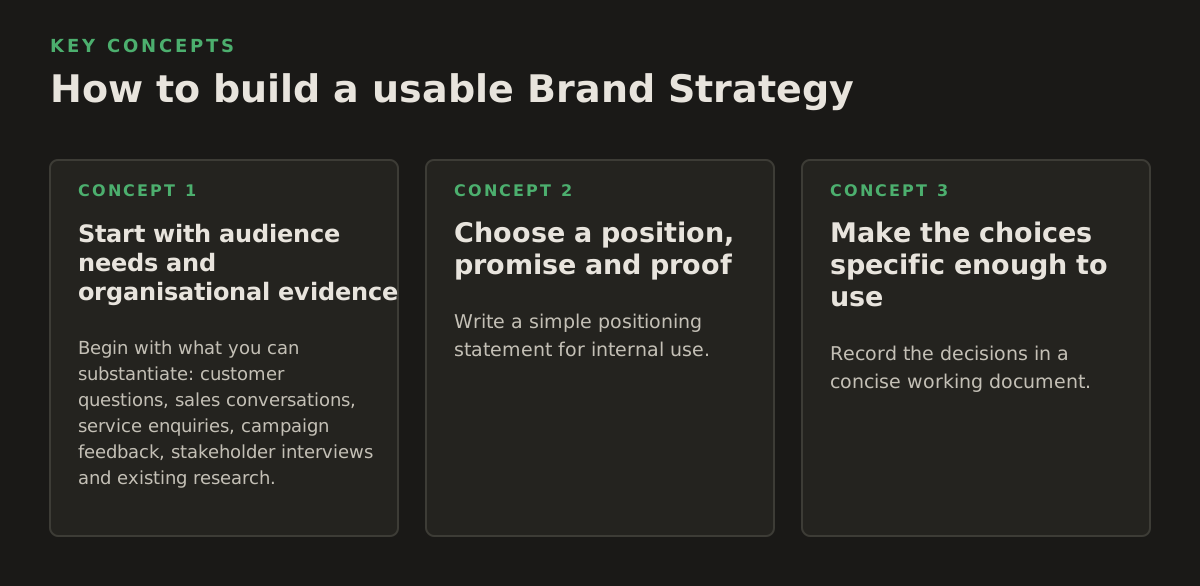
Start with audience needs and organisational evidence
Begin with what you can substantiate: customer questions, sales conversations, service enquiries, campaign feedback, stakeholder interviews and existing research. Separate observed evidence from assumptions. If your team believes customers choose you for convenience, for example, check that belief against the questions people ask and the reasons they give for choosing or leaving.
Then describe the audience in terms that affect decisions. A label such as “young people” may be too broad to guide a campaign. A more useful working description could identify a particular group, the situation they face and the information or action that would help them. Strategyzer’s explanation of the Value Proposition Canvas can help teams structure thinking about customer jobs, pains and gains; use it as a prompt for research rather than a substitute for evidence about your own audience (Strategyzer’s Value Proposition Canvas).
Choose a position, promise and proof
Write a simple positioning statement for internal use. One useful format is: “For [priority audience] who [need or situation], [organisation] is [relevant choice] because [credible difference].” Treat this as a drafting aid, not finished public copy. If the “because” clause relies on an unverified claim, the position needs more evidence or a narrower promise.
Next, define a brand promise that customers, supporters or stakeholders can recognise in practice. A promise should describe a meaningful benefit and fit what the organisation can consistently deliver. Identify the proof: a service feature, process, expertise, track record or other substantiated reason to believe. Do not use a claim simply because it sounds distinctive.
For example, an illustrative business might want to stand for “straightforward setup for first-time buyers.” Its proof would need to come from real parts of the offer or experience—such as clear instructions or an explained onboarding process—not from repeating “easy” in advertising. If the proof is not yet in place, strategy can expose a service or product improvement to address before a campaign makes the promise.
Make the choices specific enough to use
Record the decisions in a concise working document. Include the audience, need, position, promise, proof and the boundaries of the brand—what it will not claim or prioritise. Add a small set of messaging and creative principles that teams can apply, such as “show the process, not just the result” or “explain specialist terms on first use.” Those principles should follow from your strategy, not be copied as generic rules.
- List the audience and situation the strategy prioritises.
- State the most important audience need and the organisation’s response.
- Write the promise and name the evidence that supports it.
- Describe the tone and visual cues that make the position recognisable.
- Note claims, audiences or offers that need more evidence before use.
When a brand name or distinctive visual is part of the plan, check legal ownership separately from marketing appeal. WIPO explains that trademarks can protect signs that distinguish one undertaking’s goods or services from another’s; its overview is a starting point for understanding the concept, not confirmation that a particular name is available or protected (WIPO’s trademark overview).
Turn the strategy into messages and experiences
A strategy has to survive handoffs between teams and channels. Translate it into a short creative brief that tells a writer, designer, filmmaker or media planner the audience, communication task, central message, required proof and action you want people to take. A good brief carries the decision forward; it does not prescribe every line, shot or layout before creative work begins.
The same promise may need different execution in different contexts. A website can explain an offer in detail, while a short video may show a relevant moment or benefit. A public-awareness campaign may need to distinguish between explaining an issue and prompting a specific action. In each case, ask whether the audience can recognise the same intended position and whether the evidence still supports the claim.
- Website: make the audience, offer and next step easy to identify; support important claims with relevant evidence.
- Video: decide what viewers should understand or feel, then choose scenes and language that serve that task.
- Paid media: keep the audience and proposition clear across creative variations, while following the platform’s current requirements.
- PR: connect the organisation’s public comments and proof points to the position it wants to establish.
For public-facing digital content, clarity is part of the experience, not just a writing preference. GOV.UK’s content guidance recommends understanding user needs and writing content that helps users complete tasks; that is a useful discipline when shaping pages or campaign journeys, even when your organisation is not a government service (GOV.UK guidance on writing for users).
Consistency matters most where audiences compare messages or move between touchpoints. It does not mean using one template everywhere. Nielsen Norman Group’s discussion of consistency and standards explains why familiar patterns can help people use interfaces; teams can apply the same principle by keeping names, claims and key interaction cues coherent while adapting the creative to its context (Nielsen Norman Group on consistency and standards).
Measure whether the strategy is doing its job
Choose measures that match the problem the strategy is meant to address. If the issue is that people do not understand the offer, examine relevant questions, page behaviour or feedback. If the goal is to improve campaign recognition, use a measurement approach suited to that question. If the commercial goal is enquiries, track the quality and progression of those enquiries as well as their volume. One metric cannot answer every brand question.
Separate three types of evidence in your reporting:
- Delivery: did the intended audience encounter the communication?
- Understanding: did people notice, recall or correctly interpret the intended message?
- Action: did the communication contribute to the response the organisation wanted?
These stages are related, but a delivery measure alone does not show that people understood a promise or changed their behaviour. Google describes Brand Lift in Google Ads as a way to measure the impact of ads on brand metrics; consult its current support information to check whether the tool and its requirements fit your campaign, rather than assuming it is available for every plan or account (Google Ads Brand Lift help).
Search visibility can also reflect whether content is useful to its intended audience, but it is not a complete measure of brand strength. Google’s Search guidance says its systems seek to prioritise helpful, reliable, people-first content; use that as one publishing consideration, not as evidence that a page will rank or that its brand strategy is working (Google’s guidance on helpful content).
Set a baseline that matches your objective, then review evidence at a cadence the team can actually sustain. If the audience misunderstands the message, revise the explanation or proof. If the message is understood but the intended action is difficult, inspect the offer or journey. If the campaign reaches the wrong people, revisit targeting and distribution before abandoning a position that has not been properly tested.
Recognise when the strategy needs revision
A brand strategy is not a one-time document to preserve unchanged. Review it when the organisation changes its offer, enters a meaningfully different market, sees a persistent shift in audience needs or discovers that its proof no longer supports its promise. A new channel or visual refresh alone does not necessarily require a new position.
Look for specific signs of a mismatch: teams describe the organisation in conflicting ways; customers repeatedly misunderstand what is offered; campaign claims cannot be supported; or the priority audience has changed but the messaging has not. Gather evidence for the problem before changing the positioning. A temporary performance dip may have several causes, so changing the core promise without diagnosis can create more confusion.
For marketing leaders comparing outside support, ask prospective partners to explain how they move from audience evidence to positioning, messaging and execution—and how they distinguish a strategic recommendation from an assumption. Kimmel Marketing describes its own work in brand strategy and growth; its marketing expertise page can help you explore brand positioning and align creative strategy with growth goals: marketing expertise.
Review relevant examples of work for the clarity of the brief, the coherence between message and execution, and the way each piece serves its audience. You can see selected examples in the 2 Fellas Media portfolio: 2 Fellas Media portfolio. That page establishes a portfolio, not a guarantee that a particular approach will suit your organisation.
Recommendation: begin with one audience, one important need and one promise you can prove, then use those choices to guide the next brief and review what the evidence says. 2 Fellas Media is a Cape Town-based creative and marketing agency offering brand strategy, video production, web development, campaigns, PR, media placement and lead-generation automation; visit 2 Fellas Media to see whether its capabilities fit the work you need.
Authored with NotFair SEO
- brand strategy
- brand positioning
- marketing strategy
- brand identity
- campaign planning