Creative Agency Services: How to Choose the Right Scope and Provider
By 2 Fellas Media Team · November 18, 2026 · 10 min read
Creative agency services cover strategic, creative, technical and promotional work that helps an organisation communicate with an audience or support a business goal. The right choice depends on the job: a team may need clearer brand positioning, a video campaign, a new website, paid media, public relations or qualified prospects. Start with the outcome you need, then compare providers on deliverables, responsibilities, budget assumptions and how progress will be assessed.
Table of Contents
- Match the service category to the problem
- Use a decision table to narrow the brief
- Define delivery responsibilities before work starts
- Compare budget models and agree on evidence
- Screen proposals and interview shortlisted providers
- Choose a first scope that answers a real question
Match the service category to the problem
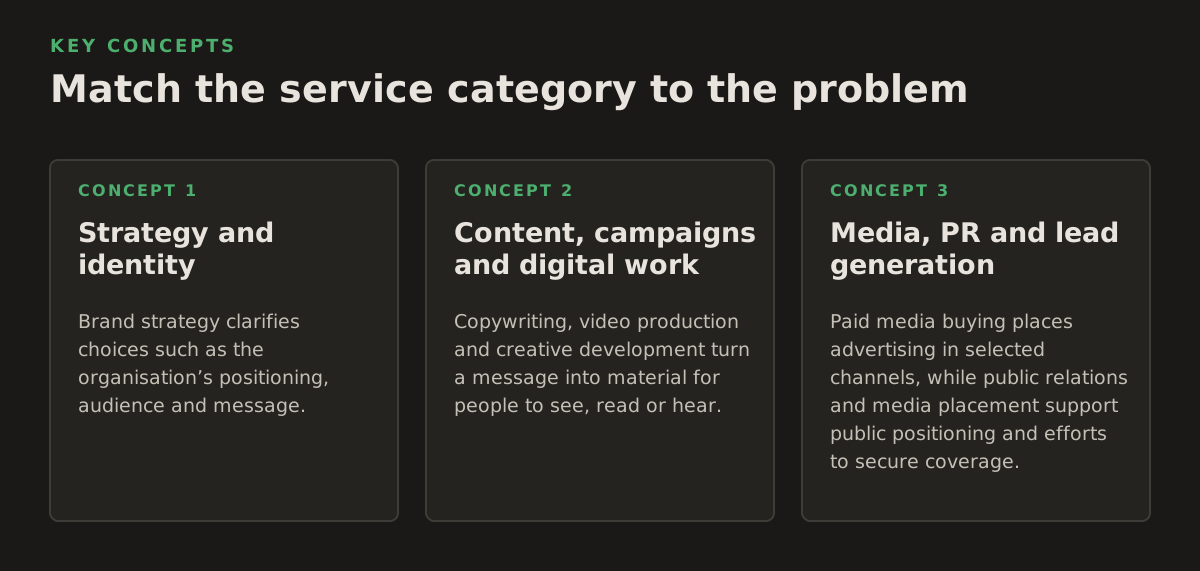
A service list describes what an agency can do; it does not establish what your organisation needs. A small business with an unclear offer may need messaging before it pays to promote that offer. An NGO with an approved campaign message but limited production capacity may need video and campaign assets. A marketing team with a site that attracts visitors but few useful enquiries may need to inspect its pages and measurement before deciding whether to rebuild.
To make the brief useful, separate three things: the business need, the deliverable and the success measure. For example, a business need might be to explain a new service to potential customers; deliverables could include campaign copy and a landing page; a measure might be relevant enquiry actions. The deliverable is what the provider makes. It is not, by itself, evidence that the business need has been met.
Strategy and identity
Brand strategy clarifies choices such as the organisation’s positioning, audience and message. Visual identity develops the design elements and guidance used to express that direction. These services can suit an organisation preparing to launch an offer, a team communicating inconsistently, or a campaign that lacks a settled message. They rely on access to people who can make decisions: if stakeholders disagree about the audience or the organisation’s priorities, design work may progress without resolving the underlying issue.
Content, campaigns and digital work
Copywriting, video production and creative development turn a message into material for people to see, read or hear. Campaign execution coordinates creative work across selected channels. Website design and development create or improve a digital experience, from a campaign destination to a broader site. These services may fit teams that know what they need to communicate but lack the production capacity, specialist skills or coordination to deliver it.
Media, PR and lead generation
Paid media buying places advertising in selected channels, while public relations and media placement support public positioning and efforts to secure coverage. Outdoor advertising planning and placement are options when the campaign calls for that format. Lead-generation work may involve finding prospect records, enriching information and qualifying leads; automation can support defined marketing or sales workflows. These activities are not interchangeable outcomes: paid reach, earned coverage and a prospect judged relevant to sales each require different work and evidence.
Examples of how a need can shape the scope include:
- A small business launching a service might first clarify its offer, then commission a page and campaign materials that explain it.
- An NGO promoting public awareness might need a consistent message and video assets, with a distribution plan suited to its intended audience.
- A marketing team with channel expertise but limited production capacity might outsource a defined set of video and copy deliverables while keeping media decisions in-house.
- A sales team seeking better prospect information might define what makes a lead relevant before commissioning research, qualification or workflow automation.
Use a decision table to narrow the brief
The table is a starting point for a conversation, not a rule that one provider should handle every task. Look at the implementation burden as well as the service: each option depends on inputs, decisions and follow-through from your organisation.
| Buyer need | Service type to consider | Trade-off or burden to plan for |
|---|---|---|
| Clarify what the organisation stands for and how it should communicate | Brand strategy and visual identity | Decision-makers need to align on the brief, audience and approvals. |
| Explain an offer or campaign in a compelling format | Copywriting, video production or creative development | Someone must supply accurate facts, contributors and timely feedback. |
| Create a campaign destination or improve a digital experience | Website design and development | Content, access, review time and post-launch ownership need to be agreed. |
| Reach an audience through paid channels | Paid media buying and campaign optimization | Agree the objective, creative, relevant tracking and how media spend is handled. |
| Strengthen public positioning or seek coverage | Public relations and media placement | Prepare credible information and allow for editorial decisions outside the organisation’s control. |
| Build a more useful prospect pipeline | Lead mining, enrichment and qualification | Define a qualified lead and decide who will review and follow up on records. |
Some projects benefit from a provider coordinating related disciplines: a campaign may need its message, creative assets and channel execution to work together. But bundling is not automatically simpler. Separate specialists may fit when deliverables are independent, your team can manage hand-offs, or a narrow technical skill is the main requirement. Compare both approaches against the same scope and measures, including who owns coordination.
Define delivery responsibilities before work starts
Hiring an agency does not remove your team from the process. Your organisation may need to supply source material, account access, approvals, subject-matter expertise or decisions about what happens to incoming enquiries. Put these requirements beside the deliverables and schedule. Otherwise, missing inputs can delay work, or the provider may produce assets without enough context to make them useful.
Map the hand-offs
For each deliverable, identify who drafts, reviews, approves and publishes it. On a website project, agree who supplies and signs off copy, who provides access to the existing site or relevant tools, and who handles changes after launch. On a campaign, identify who approves factual claims, who makes channel decisions and who responds to enquiries. The right allocation varies by project, so write it down rather than assuming that “the agency” owns every step.
Also distinguish included work from possible additions. A video scope should specify the agreed production and deliverables; ask how changes to the brief, extra versions or reshoots are handled. “Website” alone is not a detailed scope. Clarify the pages or functions included, what content you provide, how feedback works, what is handed over and what support—if any—is covered after launch.
- List the information and access the provider needs, with an owner on your side for each item.
- Name the people who can approve work and how feedback will be consolidated.
- Record exclusions, change-request handling and any handover responsibilities.
- For lead-generation work, define who receives records and how the sales team will follow up.
If you are comparing providers for a conversion-focused business website, website design services can help you compare providers when website design is among the services needed. Treat the linked page as the provider’s own description of its offering, and ask how its proposed scope fits your required pages, functions and handover.
Compare budget models and agree on evidence
Common fee structures to ask about include a defined project fee, recurring retainer, time-based billing, or a service fee with media or production costs billed separately. These are comparison questions, not a claim that every provider uses every model. Ask what each fee covers, what sits outside it, how scope changes affect the cost and what happens when the agreed work is complete. A headline total is not a fair comparison if one proposal includes different deliverables or assumptions.
Make the budget conversation specific to the work. Depending on the brief, ask whether the proposed scope includes research, strategy, production, revisions, media spend, tools, reporting and handover. If the provider recommends phases, ask what the first phase will deliver and what decision it will help you make. When funds are limited, narrowing the audience, deliverables or channels can make the work more focused than spreading the same budget across a broad list of activities.
Choose measures that fit the service
Define what the agency can affect and what depends on your organisation or other factors. A project measure might confirm that agreed pages or campaign assets are delivered; an outcome measure might look at relevant actions by the intended audience. Neither should be confused with a guarantee of business impact. For communications work, the AMEC framework distinguishes outputs, outtakes, outcomes and impact, a useful way to avoid treating a count of placements as proof that behaviour changed.
For paid campaigns, ask which actions count as conversions and how they will be recorded. Google explains that Google Ads conversion tracking measures actions after an ad interaction; this explains the platform’s tracking approach, not whether a particular provider will configure it or whether it captures the action your organisation values. Agree on the action, the account access needed and who will check that measurement is working.
For website and analytics work, choose actions that reflect your purpose rather than relying on a metric label alone. Google Analytics documentation describes key events; your organisation still needs to decide which actions matter and whether they indicate meaningful engagement or a qualified enquiry. Google’s SEO Starter Guide covers ways to help search engines crawl, index and understand a site. It is guidance on site fundamentals, not a promise of rankings or traffic.
Where historical data is incomplete, record that limitation and agree what can be measured from the start of the engagement. If sales follow-up occurs outside the agency’s systems, decide how your team will record whether an enquiry was relevant. A useful measure is one both sides can explain, collect and review—not an impressive target with no dependable way to verify it.
Screen proposals and interview shortlisted providers
Look for a clear connection between the stated need and the proposed work. A proposal can be polished yet leave key decisions unresolved. Be cautious if it recommends a channel without discussing the audience, lists outputs without explaining their purpose, or promises reporting without defining what will be measured. Clear accountability matters as much as a list of capabilities: you should know who will do the work, what your team must provide and what could affect delivery.
- Vague scope: broad language such as “full marketing support” without deliverables, exclusions or a review process.
- Unclear costs: a total that does not explain media spend, production expenses, revisions or changes.
- Unowned measurement: reports are promised, but no one defines the action or checks the tracking.
- Unclear staffing: a broad service list without an explanation of who will handle the work relevant to your brief.
- Unrealistic certainty: guaranteed coverage, leads or commercial outcomes without stated conditions and verifiable evidence.
Ask every shortlisted provider the same questions so that you can compare responses against the same criteria:
- Which part of our business need does this proposal address, and what is outside scope?
- What will you deliver, who will perform the work, and what do you need from our team?
- How are fees, media spend, production costs and scope changes handled?
- What will you measure, how will the data be collected, and what limitations should we expect?
- What might delay or weaken the work, and which decisions should we make before it begins?
Use relevant examples of past work to discuss fit, not as proof that the same approach will produce the same result for you. Ask what the original brief required, what role the provider had and how the work relates to your audience and deliverables. The 2 Fellas Media portfolio is available as a set of examples to discuss in that context; it does not, by itself, establish what your project would involve.
Choose a first scope that answers a real question
If the problem is not yet clear, commission only the discovery or strategy work needed to define the audience, message or next decision. If the need is already specific, describe the production, web, campaign, PR or lead-generation deliverables and the inputs needed to complete them. In either case, set a review point around evidence or a decision—such as whether the agreed assets are ready to use or whether the tracking captures the action you selected—rather than expanding the engagement simply because a contract period has ended.
For South African businesses, NGOs and marketing teams, compare providers on whether their proposed work fits your brief, whether your team can meet its responsibilities and whether the results can be assessed honestly. 2 Fellas Media provides brand strategy, video production, web development, marketing campaigns, media placement, PR, paid media buying and AI-powered lead generation and automation. 2 Fellas Media is a starting point for discussing which capabilities, if any, fit the scope you have defined.
Authored with NotFair SEO
- creative agency services
- brand strategy
- video production
- web development
- digital marketing