Creative Agency Website: How to Choose the Right Partner
By 2 Fellas Media Team · November 20, 2026 · 12 min read
If you need a creative agency website that attracts the right people and helps them take action, choose a partner based on the gap you need to solve—not a portfolio alone. This guide helps South African businesses, NGOs and marketing teams decide whether they need strategy, design, development or a broader campaign, then compare scope, cost structure and success measures before signing.
Table of Contents
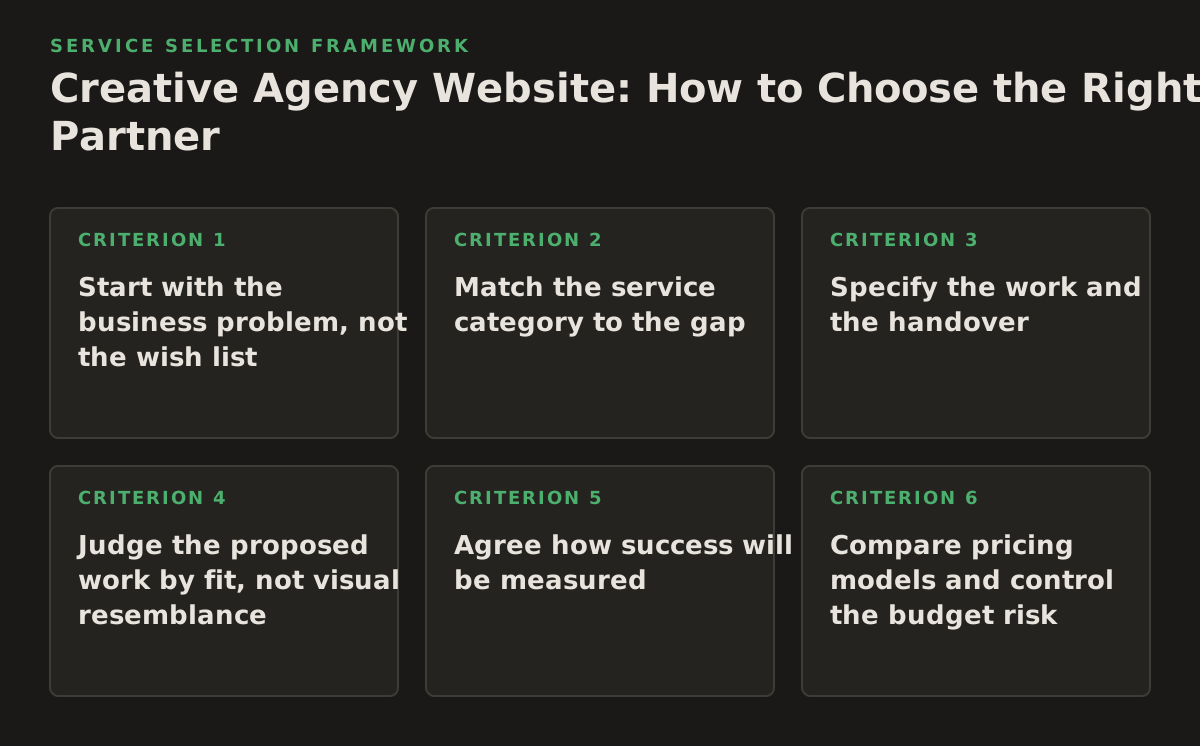
- 1. Start with the business problem, not the wish list
- 2. Match the service category to the gap
- 3. Specify the work and the handover
- 4. Judge the proposed work by fit, not visual resemblance
- 5. Agree how success will be measured
- 6. Compare pricing models and control the budget risk
- 7. Interview the people who will deliver the work
- Implementation plan: move from decision to launch in sequence
1. Start with the business problem, not the wish list
A website can clarify an offer, support a campaign, generate enquiries or make useful information easier to find. Those are different jobs. Begin by identifying what is not working now and what a better site must make possible. Otherwise, an agency may deliver a polished redesign that leaves the underlying problem untouched.
When this applies: Start here if several people have different opinions about what the new site should do, or if the brief starts with “we need a refresh” but no evidence of why. It is especially useful for an NGO balancing public information, fundraising and campaign visibility, or an SME deciding whether its site should educate visitors or capture sales leads.
Why it works: A specific business job gives the agency a basis for prioritising pages, content and functionality. For example, if prospective clients cannot tell which service fits them, a clearer service structure and stronger enquiry path may matter more than adding a blog or animation.
Turn symptoms into a testable brief
Write down the audience, the action you want them to take, and the barrier that currently gets in the way. Then record what evidence you have: sales-team feedback, common customer questions, campaign results or analytics. Google’s SEO Starter Guide also recommends making site content useful and understandable to people and search engines; treat search visibility as one part of the job, not a substitute for a clear offer.
- Audience: Who should find or use the site? Be specific, such as procurement teams, donors or local business owners.
- Action: What should a suitable visitor do next—request a quote, make a donation, register or contact a team?
- Barrier: What stops that action now: unclear messaging, missing information, a confusing form or weak campaign continuity?
- Evidence: What can you review before work begins, and who owns that information?
Failure mode: Treating a new visual identity as the business objective. The identity may be part of the solution, but it does not by itself prove that visitors understand the offer or know what to do next.
Illustrative example: An NGO running an awareness campaign might brief the agency to help visitors understand the issue and find a relevant next step. That brief is more useful than asking only for a “modern campaign site,” because it gives the team a basis for content and navigation decisions.
2. Match the service category to the gap
“Website agency” can mean anything from a designer handing over page layouts to a team managing research, copy, development and launch. Decide which category you need, then identify what your own team must supply. A broader engagement can reduce coordination between suppliers, but it also creates more decisions, approvals and dependencies.
When this applies: Use this comparison before requesting proposals, particularly when you already have an internal developer, an existing brand guide or campaign content that should be reused. Ask each provider to mark what is included, excluded and dependent on your team.
Why it works: It makes trade-offs visible. A design-only supplier may be a good fit when implementation is already covered. A strategy-to-launch engagement may suit a team that lacks the capacity to coordinate multiple specialists.
| Buyer need | Service type to consider | Typical trade-off and delivery burden | Useful success measure |
|---|---|---|---|
| The offer, audience or site structure is unclear | Discovery, brand or messaging strategy, information architecture | Requires stakeholder access and decisions before design; may add a stage before build | Agreed audience priorities, page structure and message hierarchy |
| The content is sound but hard to use or understand | UX and visual web design | Design must be handed to an implementation team; align on responsive layouts and review process | Usability feedback on priority tasks and approved page designs |
| The existing design is ready but the site needs building | Web development or a design-and-build engagement | Requires content, technical decisions and access to the existing environment; clarify who maintains the result | Agreed functionality passes acceptance checks on supported devices and browsers |
| A campaign needs a connected site and creative assets | Campaign strategy and production, potentially including video and web work | More coordination across messages, assets, media and launch dates | Campaign-specific visits and completed actions measured against the campaign objective |
| The site is live but does not support ongoing marketing well | Conversion copy, analytics setup, SEO or ongoing optimisation | Needs a reliable baseline and recurring access to content, analytics and decision-makers | Changes to a defined measure, such as qualified enquiries or form completion |
Failure mode: Buying a full-service scope because it sounds safer, without identifying who will provide approvals, copy, images and technical access. Before committing, assign an owner on your side for each dependency. If the scope includes search visibility, review Google’s SEO guidance alongside the agency’s proposed content and technical work; no supplier can guarantee search positions.
3. Specify the work and the handover
A proposal should describe how the work will be done, not only what the finished site might look like. Ask for a sequence of stages, the decision required at each stage, and the materials the agency needs from you. Clear scope protects the schedule by revealing where a delay or new request changes the work.
When this applies: Use a detailed scope when the project involves multiple departments, public-facing campaign material, a content migration or integration with existing tools. It is also important when your team expects to update pages after launch.
Check the delivery mechanics
- Discovery and structure: Does the scope include stakeholder input, audience needs, page inventory and navigation decisions?
- Content and creative: Who writes, edits and approves copy? Are photography, illustration, video or translation included, or supplied by you?
- Build and acceptance: What functionality is included, who enters content, and how are defects distinguished from new requests?
- Ownership and handover: Who controls the domain, hosting, accounts, files and credentials? What documentation or training is part of delivery?
- After launch: Is support included for a defined period, available under a separate agreement, or left to your team?
Check the site’s accessibility expectations early rather than treating them as a final polish task. The W3C’s WCAG overview describes accessibility guidance for making web content more accessible to people with disabilities. Ask the provider which requirements they will address, how they will check them, and which decisions remain yours; avoid accepting a vague promise of “fully accessible.”
Failure mode: Approving designs before anyone has agreed who supplies final copy and images. Late content can force layout changes and extra review rounds. Illustrative implementation: Add a content owner and due date beside every page in the project schedule, and make written approval of page copy a prerequisite for design sign-off.
4. Judge the proposed work by fit, not visual resemblance
A portfolio helps you understand a provider’s work, but similar-looking projects are not proof that the approach fits your audience, content or constraints. Review examples for the problem solved and the decisions behind the work. If an agency describes an outcome, ask what it measured and what other factors could have influenced it.
When this applies: This is useful when comparing agencies whose work all looks polished, or when a team needs confidence that a supplier can work within an established brand rather than replace it. NGOs can also check whether the provider understands how campaign information, public trust and calls to action need to coexist.
Why it works: Asking about process exposes whether the provider can explain trade-offs. A site for a lead-generation campaign may prioritise a short path to enquiry; an information-heavy organisation may need stronger navigation and content structure. Neither goal is automatically superior.
Use the same questions on each portfolio example
- What was the client’s objective, and which audience was it for?
- Which parts did this provider handle: strategy, content, design, development or marketing?
- What constraints shaped the work, such as existing materials or internal approvals?
- How was success defined, and can the provider explain the evidence without implying that design alone caused it?
For a direct reference point, 2 Fellas Media’s 2 Fellas Media portfolio identifies its work page. Review any work there against the same questions; the page label alone does not establish the scope or outcomes of an individual project.
Failure mode: Selecting a provider because its examples match your preferred aesthetic while skipping the implementation details. A visual direction still needs to support your content, user tasks and team’s ability to maintain the site.
5. Agree how success will be measured
Before work begins, decide which measure indicates progress toward the business job—not simply activity such as pages delivered or visits received. A site can attract traffic that is irrelevant to the organisation. Conversely, a low-traffic information page may still be useful if the intended audience can complete its task.
When this applies: Establish measures for all projects, but give extra attention to them when the site supports paid campaigns, lead generation, fundraising or ongoing marketing. Define what counts as a qualified enquiry or completed action before reporting starts.
Make the measurement plan operational
- Record the starting point and note any limits in the available data.
- Choose a primary measure tied to the objective, such as qualified enquiries, completed registrations or donation actions.
- Choose a supporting measure that helps explain the result, such as form abandonment or visits to a priority service page.
- Confirm who will set up tracking, check it after launch and interpret results.
- Set a review date based on the project and campaign cycle; do not promise a result before there is evidence.
Google Analytics documentation describes event-based measurement, which can help teams define interactions to track. Agree on the events and reporting responsibilities with the provider rather than assuming that adding analytics automatically produces useful measurement.
Failure mode: Setting a target for total visits without checking whether visits lead to the action that matters. Illustrative example: For a service page intended to generate business enquiries, track submitted enquiries and review their relevance with the sales team; use page visits as context, not as the sole measure.
6. Compare pricing models and control the budget risk
There is no meaningful comparison of proposals if one includes strategy, copy and launch support while another covers design alone. Compare each proposal against the same deliverables and assumptions. Ask how changes, extra review rounds, third-party costs and ongoing work are priced; do not infer a market price from a proposal built around a different scope.
Common pricing structures: A fixed-scope fee can help when requirements and acceptance criteria are clear, but changes may require a revised quote. Time-based billing can suit discovery or evolving work, but requires agreement on rates, reporting and approval of additional hours. A recurring retainer may support continued optimisation or content work, but define what capacity, deliverables and response expectations it covers. These are structures to compare, not price recommendations.
Budget questions to ask:
- Which deliverables and review rounds are included, and what triggers additional fees?
- Are content production, migration, hosting, licences, travel or media spend separate?
- When are payments due, and what happens if your team delays approvals or content?
- What happens to unfinished work, source files and access if the project ends early?
- What post-launch support is included, and what would require a new agreement?
Failure mode: Choosing the lowest quote without checking omitted tasks. A site may appear affordable until the team discovers it must source copy, migrate content or arrange maintenance separately. Build an internal budget that accounts for both the supplier’s scope and your team’s time, then request revisions if proposals do not cover the same work.
7. Interview the people who will deliver the work
Ask the proposed team to explain decisions in plain language. The goal is not to test technical vocabulary; it is to see whether the people doing the work can connect their process to your audience, constraints and goals. Confirm who will attend meetings and make day-to-day decisions, not only who presented the proposal.
Vendor interview checklist:
- What would you need to learn before recommending a site structure or visual direction?
- Who will lead strategy, design, development and project management, and how much of the work is subcontracted?
- How do you handle approvals, scope changes and disagreements about design or functionality?
- What will our team need to supply, and what internal time should we reserve for reviews?
- How do you test the finished site, and what does acceptance mean for this specific scope?
- What accounts, files and documentation will we control at handover?
- Which results can you measure directly, and which depend on our offer, traffic or sales follow-up?
Red flags: guaranteed business results without agreed measurement; unclear ownership of accounts or files; a proposal that avoids naming exclusions; or a process that cannot explain who approves what. A provider may still be suitable if a capability is outside its scope, provided the gap is explicit and you have a plan to cover it.
Implementation plan: move from decision to launch in sequence
- Write a one-page decision brief. State the audience, business job, current barrier, desired action and evidence available. Name a decision-maker who can resolve conflicting feedback.
- Choose the service scope. Use the table to identify the smallest combination that solves the problem. Add specialists only where their work has a defined purpose, and assign responsibility for every excluded task.
- Request comparable proposals. Give each supplier the same brief, page or feature priorities, content assumptions, deadline constraints and measurement goal. Ask for deliverables, dependencies, review rounds, pricing structure and handover terms in writing.
- Interview the delivery team. Use the checklist, review relevant portfolio examples and ask each provider to explain one trade-off they would explore—not to prescribe a solution before discovery.
- Agree the baseline and acceptance checks. Confirm the primary measure, who tracks it, what the launch must do, and how the site will be checked for usability, content and agreed functionality.
- Launch, then review against the original job. Check that measurement works, gather feedback from the intended audience or frontline team, and prioritise changes using evidence rather than redesigning by instinct.
2 Fellas Media’s verified capabilities include brand strategy, website design and custom web development, conversion-focused copywriting, video production and multi-channel campaign execution. If that combination matches your brief, explore 2 Fellas Media as one option and compare its proposed scope against the same criteria you use for every supplier.
Authored with NotFair SEO
- creative agency website
- web development
- brand strategy
- digital marketing
- website design